 Simplified Startup
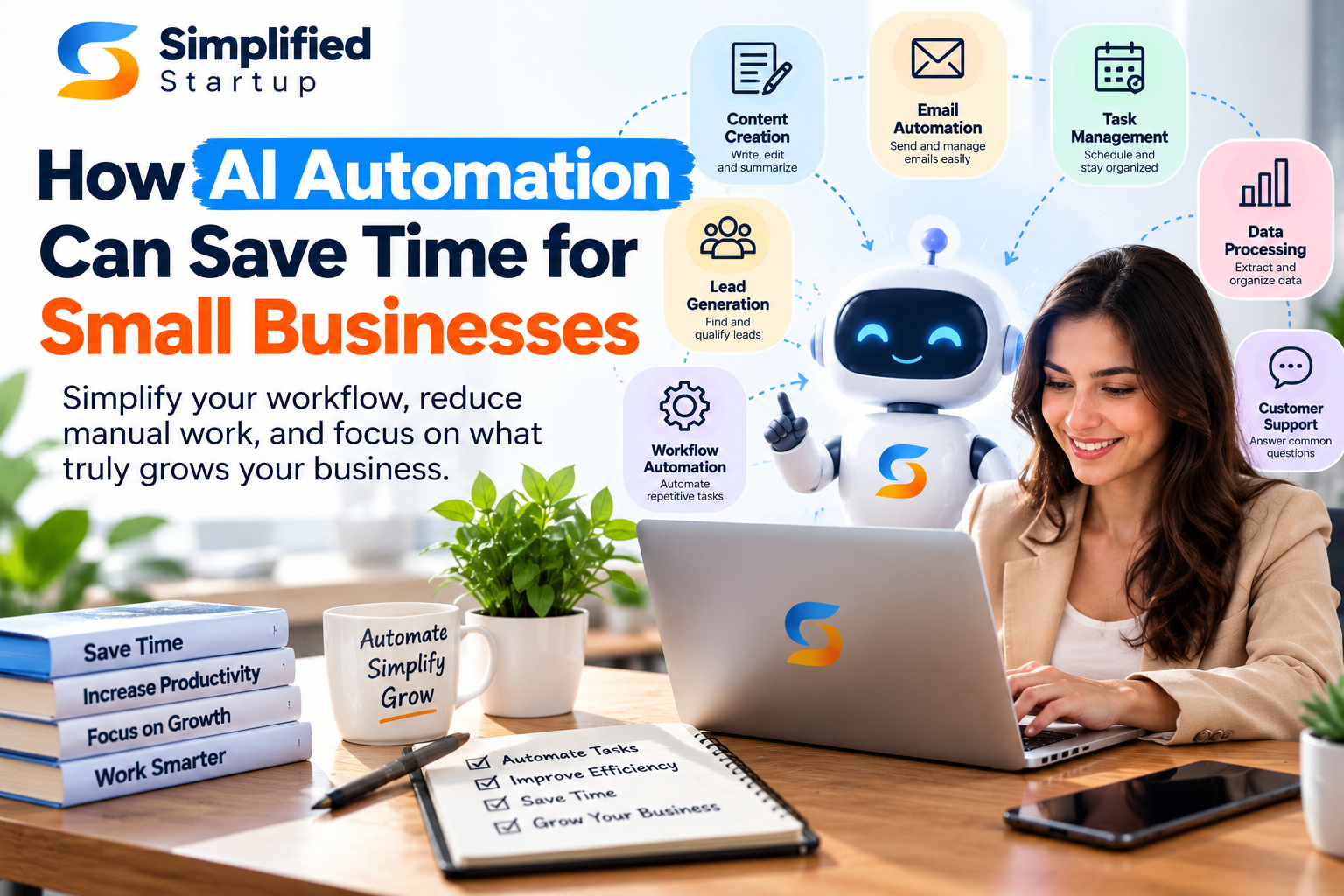
How AI Automation Can Save Time for Small Businesses
A 2025 research study from MIT’s NANDA initiative indicated that almost 95% of the firms it looked at saw no meaningful return from their generative AI experiments. The sample was limited and the authors describe their own results as directionally accurate rather than audited so regard the number as a signal rather than a law. What the lead author mentioned about why is the useful part.
The models weren’t that horrible. The tools and the real flow of work through a corporation were not aligned. It was integration that failed, not intelligence.
That’s why it matters more to you than it does to them. A corporation of 100 people has handoffs, approvals and protocols that no one knows all of the answers to. You have a spreadsheet. You have an inbox. You have four tools. The gap that drowned their pilots is considerably tighter in your firm. AI automation for small business operations is one of the rare technology stories where being small is the benefit.
Begin with the time audit, not the tool
Almost everyone does it wrong. They view a demo, buy the subscription, and then look around for something to utilize it on.
Spend a week writing down what you do in fifteen minute increments. It is tiresome and it is the only step that works reliably. What you’ll wind up with is a list that mostly falls into four groups.
Only you can do things. Selling. Judgment calls. Relationships. The craft itself.
Anyone can follow and do these rules. Moving data across tools. Chasing invoices. Scheduling. Filing. Formatting.
Things need a first draft and then a human. Reports. Answers. Tips. Summaries. Lists.
Things that shouldn’t be there. A weekly report no one reads. A form you fill out twice.
In the third group artificial intelligence can be of use. The second group is where straightforward automation helps. That distinction is worth more than any tool recommendation.
The difference that no software salesman will tell you
Mixing both of them together is costly. Under one umbrella, two completely distinct items are being offered.
Workflow automation for small business tasks is based on rules. Create a row when a form is submitted, send an email, alert a channel. It does the exact same thing every time. It’s inexpensive, it’s auditable, and when it breaks it breaks loud.
AI automation is probabilistic. It provides a different answer every time and is highly strong at language, summarizing, writing and classifying chaotic input. It is also capable of being confidently wrong, and when it fails it usually fails silently.
The first type of problem is where a small business loses most of its hours. Data manually transported between two systems. The same confirmation email typed out 90 times a month. It’s a rules problem, and it’s a longer, more expensive and less reliable way to solve it than with a basic automation tool.
Use AI for judgment about language. Apply rules to all the unchanging elements.
AI tools for small businesses that earn subscription
Categories, not brands, as by the time this becomes relevant, the brands will have changed.
Drafting and re-writing. Job advertisements, product descriptions, answers, proposals. The win is the first draft, not the ultimate draft.
Summarizing. Action notes, email conversations that go lengthy to a decision, customer call to record.
Classify and route. Reading an incoming message, tagging it, prioritizing it, forwarding it to the correct destination.
Extracting data. Taking line items from invoices and receipts and structuring them in a way you can use.
Research with verification. First-pass scanning. You scan for anything that matters before you do anything.
Things that don’t tend to earn their keep: everything that needs to be accurate first time with no review, anything that requires extensive context about your individual clients, and anything where the output gets straight to a client without a human reading it.
The arithmetic that practically nobody runs
Do this prior to paying for anything. It takes five minutes and it will destroy around half your ideas. Which is the objective.
Hours per month the task takes. Be honest, utilize the time audit instead of a guess.
Whoever does it, your loaded cost per hour. The salary plus taxes and overhead, not the wage.
Hours to set up, including the sections that don’t function first time.
Ongoing maintenance. Every automation will fail eventually and this is the line everyone forgets.
Four hours a month at a loaded cost of forty dollars. One hundred and sixty dollars worth of time. A $40 membership + six hours of setup means that in month three you’re making a profit, assuming nothing breaks. If it takes twenty hours to set up, the automation doesn’t pay back in a year, so you should either simplify it or leave it alone.
Run that math on every prospect before you launch one free trial.
A Worked Example, end to end
A two-person cleaning company spends most of its admin time on the same cycle. An inquiry comes in by form or text, somebody responds with availability, an estimate goes out and a confirmation follows. Let’s say it’s five hours a week.
Few of it needs AI if broken into pieces.
One place for the inquiry to land is a rules job. No copying, one sheet, one inbox.
It’s a rules job, the acknowledgment. Automatically, within a minute, with a realistic time for a full response.
A language job is reading a complicated message and figuring out what the customer really wants. That’s where AI should be, drafting out a draft.
Pricing is a human issue. Always.
Again rules jobs with the reminder and the confirmation.
One language step in four rules steps. That’s what real automation looks like most of the time. This is the reverse of what a demo shows you. The owner still reviews every quote before it travels, and the five hours becomes something like an hour and a half.
Business Process Automation - the way that works
What matters is the order of things, not the instruments.
First fix the procedure. When you automate a terrible process, you get a quick bad process, and it’s tougher to detect what’s wrong.
Write down the stages as they happen, including exceptions. The exception is where all automation projects die.
Automate the dull midsection. The receiving and the deciding are nevertheless often human. It is the shifting and the copying and the formatting in between that takes the hours.
Keep a person in the loop wherever a mistake would cost more than the time saved.
Choose one process, finish it, implement it for a month. Do the next one.
Companies who try to automate five processes simultaneously frequently wind up with five half-automated processes and less faith in the concept than they had when they began.
What to not automate
Anything a customer reads that wasn’t vetted by anyone. One price quote that is confidently inaccurate costs more than a year’s worth of saved minutes.
Prices, terms of contracts, anything that has legal weight.
Communications for hire and fire. The decision and the words belong to a person.
Handling complaints. An unhappy consumer can smell it, and it makes a bad situation worse.
Anything with customer data in a tool you haven’t checked. Before you paste anything in, check if that tool trains on your inputs and where the data is saved. If you handle health, financial or client confidential information, this is not optional.
The relational side of your business. The stuff that people really buy from you.
Benefits of AI Automation, Plain and Simple
The benefits of AI automation are real, and they tend to be smaller and more boring than the marketing promises.
Time back, in bits. Here for twenty minutes, there for an hour. It accumulates, but you won’t feel it the way you feel a new hire.
Less errors with repetitious work. Machines don’t get bored at item forty.
faster reaction times, which translates better than anything else you could modify in most service firms.
Capacity without headcount. You can boost your workload until it’s time to hire someone new.
Less of the work you dislike - and this is more important for a small business owner than any efficiency metric - because it’s frequently the reason people burn out.
What you shouldn’t expect: a transformed business, a replacement employee or anything approximating the demo. The demo was constructed on clean data by someone who knew the solution already.
The Costs Nobody Talks About
Every automation is a device that can break silently, and silent failure is worse than screaming failure.
The email that stops sending is obvious. A classifier that starts misrouting one in ten messages is not, and you will hear about it from a client. So add a check: a weekly look at the output, a count that should be roughly the same every month, something that shows you the item is still alive.
And there is the subscription drift too. Six tools at thirty bucks a month is a part-time wage and tiny enterprises rack them up without ever auditing them. Put a date on the calendar to cancel what you stopped using.
Where the data ends up
Three questions before anything with client details touches a tool.
Does this tool learn from what I feed it? Many free tiers say yes, many business levels say no. It is contingent upon what plan you are on. The solution is in the terms.
Where is the data saved and for how long? Deleting a chat isn’t necessarily the same as deleting the record.
What if this was where it should not be? If the solution concerns a regulator or a contract or a client’s trust, that work is not a candidate until the tool question is satisfactorily settled.
That’s no excuse to avoid the tools. That’s a reason to take twenty minutes to study the conditions of the one you’re about to put your client list into — which is twenty minutes more than most firms spend.
Four blunders that kill the first month
Getting the tool prior to writing the problem. The time audit is there to prevent this.
Automating the hardest procedure first, usually because it’s the most bothersome. Instead start with the most repetitious one. The early win is more important than the big one.
Creating something only you understand. If it breaks while you are away and no one else can observe how it works, you have created a risk instead of eliminating one.
Judging it on how impressive it feels, not on the number you wrote down at the beginning.
How to run a two-week trial
Small, bounded and with a number attached.
Select a task from the time audit, the most repetitive one you can identify.
Write down the hours it takes today and the error rate you live with today.
Build the tiniest thing that might possibly work. But not the whole answer.
Run it in parallel with the manual process for 2 weeks, not instead of it.
Compare. And if it saved less than you thought, stop and say so clearly instead of convincing yourself.
People neglect the step of running it in parallel with the old procedure. This is the step that prevents a silent failure from reaching a client.
Where Small Businesses Should Really Start
If you’re looking for a place to start, it’s hardly the interesting one.
Start with the first-response problem. Most small firms lose more money to slow responses than anything a language model could design for them. A routing rule, an auto acknowledgment, and a draft initial response that a person authorizes will generally beat anything else you could automate in that same week.
The second location is quotations and proposals since that is where owners lose their evenings. So a template plus a drafting helper plus a human check makes a ninety-minute job twenty minutes without ever putting anything unreviewed in front of a client.
Frequently Asked Questions
So what does AI automation for small business mean, in simple terms?
Using AI for sections of a work where language or some judgment regarding messy input is needed. Usually with a person checking on the output. This is unlike rules-based automation, which always does the same thing and accomplishes most repetitive job better.
What’s the cost to begin with?
Subscription terms: Less than most people think. Setup time: More than most people think. The real number is your own: hours saved multiplied by your loaded hourly cost, less the subscription, less setup, less maintenance.
Will AI automation replace my workers?
No, for most small firms. It takes away pieces of jobs, rather than full jobs. And the practical impact of it is that you tend to put off a hiring decision, rather than lose somebody.
What are the best AI tools for small businesses?
The relevant question is, what group does worst task fall into? The four most typically rewarded are drafting, summarizing, categorizing and extracting. Anything that says it’ll run your business is selling a demo.
What is the difference between workflow automation and AI automation?
Workflow automation is predictable, inexpensive and auditable. It follows a fixed set of rules. AI automation handles language and ambiguity and can be confidently inaccurate. In a small business, the first one is the biggest time-saver.
How do you know it’s working?
Measure the same item before and after: hours spent, reaction time, mistake rate. If you can’t say what you’re measuring, you won’t be able to say if it worked or not, which is pretty much what happened with the MIT findings.
Where this leaves you
The failure rate of that MIT report is no reason to stay away. It’s a description of what happens when you buy tools before you know what the problems are.
You have an edge that larger businesses don’t: you know exactly where your week goes and you can change a process on a Tuesday afternoon without a committee. Do the time audit for the week. Do the math for three candidates. Automate one thing well.