 Simplified Startup
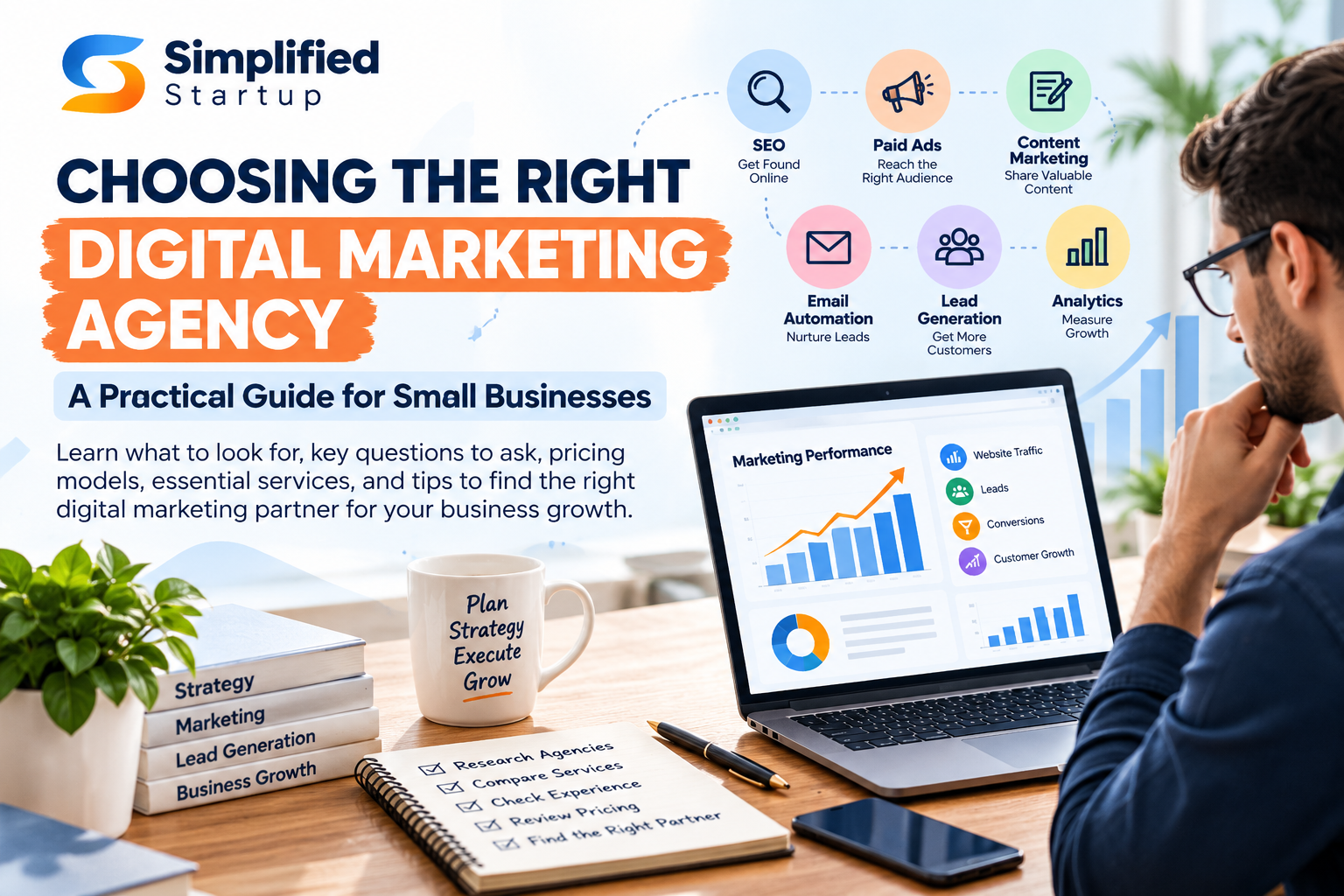
How to Choose the Right Digital Marketing Agency for Your Small Business
Basically every marketing budget article tells small business owners to spend seven to eight percent of revenue. Almost all of those articles credit the Small Business Administration with that percentage. Try to locate the SBA document it is drawn from. It’s cited everyplace, but sourced nowhere.
It is a good thing to observe before you hire anyone, because the industry you are about to buy from runs on numbers like that: confidently repeated, rarely checked. Give your money to agencies that can demonstrate the source of their figures.
Here’s how to differentiate them.
Before you make one call decide what you are buying
The most expensive mistake is engaging a digital marketing agency for small business work before you know what problem you are tackling. Agencies are only too happy to sell you a package. Packages are how you pay for social media when your real problem is no one can find you on Google.
Nobody knows you’re alive. That’s a visibility problem, and it points to SEO, content and sponsored search.
People find you and don’t convert. That is a website and messaging problem and no amount of traffic changes that.
You win leads, and lose leads. That’s a downstream problem, and it’s a sales and email automation problem before it’s an advertising problem.
You are expanding yet you don’t see what works. That is a measurement problem and it is the cheapest to address.
In one statement write down which one of these is yours. Then hold each agency you talk to accountable to that statement, not to their own deck.
How Agencies Bill You (And What They Reward)
Pricing model is not a detail. It decides what the agency is incentivized to do when no one is looking.
Retainer monthly. Predictable on both sides. Rewards that keep you, not necessarily push you. Ask what happens to the charge if you need less work in month 6.
Project charge. Good for a discrete piece like rebuilding a site. Not good for anything that requires constant tweaking.
Every hour. Principally transparent. In reality you pay for inputs not outcomes and nobody ever audits the timesheet.
A percentage of ad spend, typically between ten and twenty percent. Once you say it out loud, the conflict is evident: the agency makes more money when you spend more money, even if the decision to spend more money was wrong.
Commission or performance. Sounds perfect and is the toughest thing to do honestly because it relies on attribution that both sides are comfortable with. Get the definition of a qualified lead in writing before anything begins.
None of this is wrong. A percentage model with a spending cap you control is okay. Retainer with quarterly scope reviews is okay. What is not fine is a model about which you have never been told.
It’s mostly public and no one really checks it.
Google Partner status. Don’t take the badge on their site. Google reviews the standards every day and offers a sixty day grace period. This implies a badge on a site can be out of date. Instead try looking up the company in Google’s own partner directory.
Who actually does the work. The person pitching you is not usually the person operating your account. Ask for name, seniority, how many other accounts they handle and if any of it is subcontracted.
Your choice of references, not their choice of references. Request 2 clients in your revenue range who left in the last year. The reaction to that question is more informative than the answer.
Case studies with arithmetic. “Increased traffic by 300%” from a baseline of four hundred visits is forty minutes of work. Ask for the starting number, the time period, and the spend.
Their own advertising. An agency that doesn’t rank for anything and doesn’t advertise for anything is either very busy or not very good, and it’s fair to ask which.
What Each Of The Digital Marketing Services Actually Is For
The menu is a long one and the answer for most small firms is two or three items, not nine.
Search engine optimization (SEO). Slow and cumulative. Realistically expect 6-12 months before seeing meaningful movement, longer in competitive sectors. Worth it when your clients are searching for what you sell.
Search, but paid. Fast, quantifiable and quits when you stop paying. The first right move whether you need data fast or revenue today.
Paid social. Better at demand creation than demand capture. Because people on social are not looking for you, the creative needs to work harder.
Content. Powers SEO and provides sales something to send. Slow and the thing most commonly outsourced badly.
Email & automation. For most small firms, it’s the biggest return per dollar but also the most neglected because it’s unglamorous, and nobody puts it in a pitch deck.
Conversion rate optimization. Renovating the site you already own. Generally cheaper than buying extra traffic, yet it’s nearly always skipped.
If an agency is recommending all six in month one, they are selling capacity not strategy.
What a paid realistic budget looks like
No one can give you a monthly amount without knowing your market and anyone who estimates one on the first call is guessing. But you can do the floor yourself, it takes two minutes.
Paid platforms need conversion volume to optimize. Around thirty conversions a month is the point where the algo has something to learn from. So the math runs backward from there.
Figure out your average cost per click. The standard for your category is published and your agency should be able to show you theirs with a source.
Let’s take a landing page conversion rate. A good page will be between two and five percent.
Thirty conversions at three percent is a thousand clicks. Four bucks multiplied by a thousand clicks equals four thousand dollars a month.
Change any of those three inputs and the response changes completely. That’s the entire point. If your category is twelve dollars a click, the floor is three times higher. An agency that gets you into paid search on a thousand-dollar budget has set you up to fail and will still bill you.
Make this calculation before the initial call. The quickest approach to find out if the person at the other side of the table is telling the truth.
Why the benchmark figures don’t apply to you?
The percentages for the circulating budget come largely from studies of major companies and the distribution among them instructs you not to use the average.
A frequently cited industry survey has an average marketing spend of slightly under nine percent of revenue and a median of five. The whole story is this gap. A few really large spenders pull the mean up, and the usual company in the sample is much below that. To quote the mean to a small business is not a benchmark, it is a sales tool.
Do the math yourself. How much is a customer worth to you in a year, how many can you actually service and what can you do without for three months and not feel the pain. Those three answers provide you a budget that is yours, that belongs to your firm, not to someone’s survey.
You are probably being oversold on digital marketing services
There are three things that get sold to small businesses way more than they need.
Daily post on all social platforms. The volume on a platform your consumers don’t buy from is the cheapest thing an agency can make and the easiest thing to put in a report.
The first move: a complete revamp of the website. Sometimes needed. Often it takes six weeks of delay and a big invoice before anything measurable happens.
Broad SEO on high volume national terms while your firm serves 1 metro area. The traffic comes and doesn’t convert. And it takes a year to find out.
None of these are cons. They just sell easier than the non-glamorous digital marketing services that normally move the needle: improving your site, writing better offers, and following up on the leads you already get.
How to hire a marketing agency: The Procedure
How to hire a marketing firm is primarily about slowing down the first two weeks.
Just write down the one sentence problem, a number you’d like to see move, and the date you’d like to see movement by.
Three on the short-list. Anything past that and you’ll be comparing decks not thinking.
Write down the same questions in advance and ask all three of them the identical questions. Pitches are meant to direct the conversation.
Ask for a paid discovery or audit before signing a long contract. Be prepared to pay for it. If an agency is willing to conduct serious diagnostic work for free, either they are offering you something generic or they are making up the expense elsewhere.
Start small. Not a year. Three or six months with a fixed scope.
Get ownership in writing before you join up.
The last one is more important than any of the above and is the issue that small businesses most commonly get wrong.
Own your own accounts
Your Google Ads account. Your Google Analytics property. Your Meta Business Manager. Your domain registration. Your website hosting. Your email list. All of these should be held by your firm and access provided to the agency.
When you leave, three things happen if the accounts belong to the agency. You lose historical data i.e. next agency starts blind. You will lose the ad account’s learning history. And you realize that the power in the relationship was never yours.
It’s a two line clause in a contract and it’s the most valuable thing in this post.
Startup marketing services are a different story
If you don’t have clients yet, most of the following advice is premature.
A startup isn’t optimizing a funnel it’s looking for one. SEO is pricey patience before you know who buys. Agencies that offer startup marketing services should be talking about positioning, message testing and affordable experiments, not 12 month content calendars.
What generally helps first. Get clear on who the customer actually is, perform modest paid tests to find out which message generates a response, and then only construct anything that compounds. A founder who controls the messaging learns faster than one who outsourced it in month 1.
Red flags
Guaranteed ranks. Google itself advises against anyone guaranteeing a number one spot. The algorithm is not controlled by anyone.
A proposition before diagnosis. It was written before the call if they know the solution before they have viewed your analytics.
Reports showing solely impressions, reach and traffic. That’s action, not results.
12 month contracts with no leave clause and no performance review point.
Pressure to make a decision this week. Expired discounts are a sales gimmick, not a reflection of value.
Uncertainty as to who conducts the work, and where.
What an excellent agency will tell you that you don’t want to hear
Your website needs fixing, before you spend money on traffic. It is realistic to say six months and not three. Your category is expensive and your budget is not enough to compete. And here is what to do instead. That portion of what you wanted is not going to work.
If an agency agrees with everything you say in the first meeting, they are selling. The service is the disagreement.
What to measure in the first 90 days
Agree these before you start, because then it turns into a negotiation.
Sales or leads, with a documented joint definition of what qualifies.
Cost per lead, cost per acquisition, trending.
For SEO, ranking for the keywords that truly make money, not vanity keywords.
One honest paragraph a month on anything that didn’t work.
90 days is plenty to see direction for paid and nothing conclusive for SEO. It’s knowing that beforehand that stops the conversation where you cancel a campaign two months before it would have worked.
Frequently Asked Questions
What is the cost of a digital marketing agency for small business?
The scope and demand for retainers can vary greatly, so be skeptical of any single figure. Then use the above conversion math to get out your paid budget floor. Ask each agency to quote against your one sentence problem rather than against a package.
How long till I get results?
Paid search provides relevant data in two to four weeks, and revenue sooner than anything else. SEO takes 6-12 months to get results. If you have a list you can do email and get returns in days. Any agency shortening these timescales is managing your expectations, not your campaign.
Should I engage a freelancer or a small business marketing agency?
Usually a freelancer is the best value for one skill. An agency is better if you have numerous disciplines that need to cooperate or you require cover if someone’s not accessible. The big question is, do you have the time to handle multiple freelancers yourself?
What should be in a contract?
Scope, deliverables, reporting frequency, identified account manager, notice period and ownership of each account and asset. If ownership is not in there, do not sign it.
Can I start small and grow?
Yes, you should. The agency’s performance on one channel over three months tells you more than any pitch. Broadening scope after witnessing real work is a far better place to be than bargaining your way out of a twelve month commitment.
What if it doesn’t work after 3 months?
Ask for the diagnosis, not the reassurance. A reputable agency will tell you if the problem is the channel, the budget, the offer or the website and will do so even when the response is adverse to themselves.
Where This Gets You
The ruling is not as sweeping as the market portrays it to be. You’re not deciding between agencies. You are hiring someone who can tell you where their figures are coming from, who can tell you what will not work, who will leave your accounts in your name.
The rest is presentation.
Schedule a consultation and bring the one sentence version of your concern.